
Disputed
The northern edge of Tulu Nadu is not settled. One account says that in history Tulu Nadu reached from the Gangavalli river in Uttara Kannada to Nileshwar in Kasaragod. That is what the Tulu Nadu article on Wikipedia says. The other puts the line much closer, at the Swarna river in Udupi district, which people also call the Kalyanapura river. The Dakshina Kannada district gazetteer records this view as a traditional saying. In the saying, Tulu Nadu is the coast from the Chandragiri in the south to Kalyanapura in the north. Neither is preferred here. The two answers may measure different things. Under Vijayanagara the province called Tuluva Rajya reached Gokarna, and it included land where people did not speak Tulu. In Kundapura and the north of Udupi district, people speak Kundagannada, a form of Kannada. The southern edge is less in doubt. Most accounts put it at the Chandragiri river, also called the Payaswini. The Wikipedia account starts at the Gangavalli. It goes south past the Chandragiri to Nileshwar. The historian N. Shyam Bhat puts the line of Tulu speech at the Chandragiri. He says Tulu culture spreads further south, to the Kavvayi river by Nileshwar. This page keeps both readings, for the north and for the south.
Tulu Nadu (ತುಳುನಾಡ್, tuḷunāḍ) is the Tulu-speaking land on India’s west coast, between the Western Ghats and the Arabian Sea 1. This page covers where it begins and ends, what it has been called, and its districts and towns.
Tulu Nadu is not a state or a district today 1. It is a region where people share a language and a culture. Today it falls across three districts in two states: Dakshina Kannada and Udupi in Karnataka, and the northern part of Kasaragod district in Kerala 2 3 4. The rivers, the soil and the monsoon have a page of their own, the land itself.
Where Tulu Nadu begins and ends
Most accounts put the southern edge of Tulu Nadu at the Chandragiri river 5 6 1 4. The Tulu Nadu article on Wikipedia calls it the old border on the south 1. The article’s wider account starts at the Gangavalli. It goes on past the river to Nileshwar 1. Nileshwar lies in Hosdurg taluk, south of the Chandragiri 4. The historian N. Shyam Bhat puts the line of Tulu speech today at the Chandragiri 4. He says Tulu culture spreads further south, to the Kavvayi river by Nileshwar 4. In Karnataka the same river is called the Payaswini 7. It rises in the Talakaveri sanctuary in Kodagu and runs 105 km to the sea. It is the longest river in Kasaragod district 7 8. Since at least the fourteenth century, people have treated it as the line between Tulu and Malayalam speech 7 8. Sixteenth-century Portuguese travellers recorded it as Rio Cangerecora 7.
The northern edge is disputed. One account says that in history Tulu Nadu reached from the Gangavalli river, far north in Uttara Kannada, to Nileshwar in Kasaragod 1. Another puts the line much closer, at the Swarna river in Udupi district, which people also call the Kalyanapura river. The article on the Alupas says the land between the Swarna and the Chandragiri was called Tulunadu late in their rule 9. A traditional saying draws it there too: Tulu Nadu is the coast from the Chandragiri in the south to Kalyanapura in the north 5. This page keeps both answers and prefers neither.
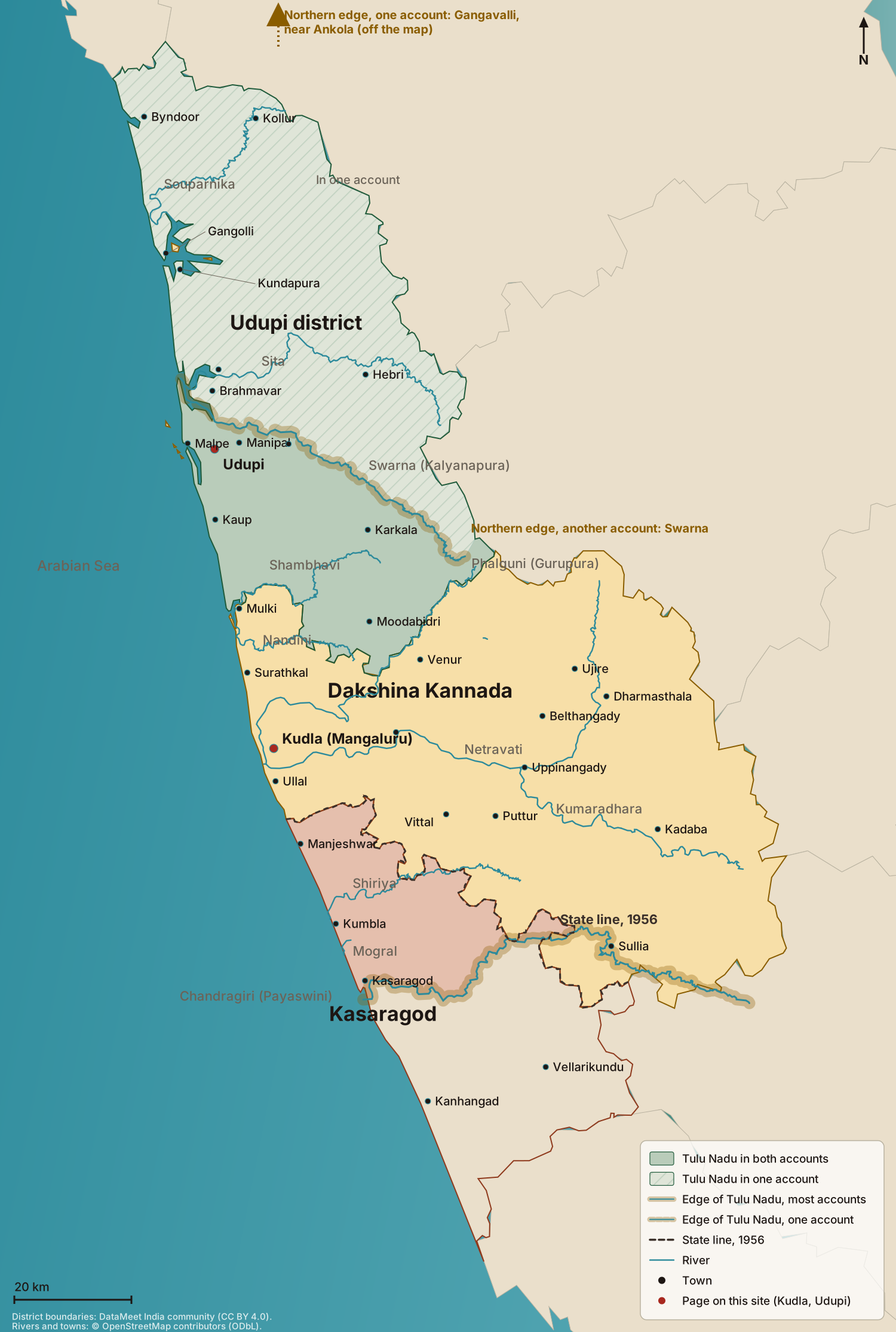
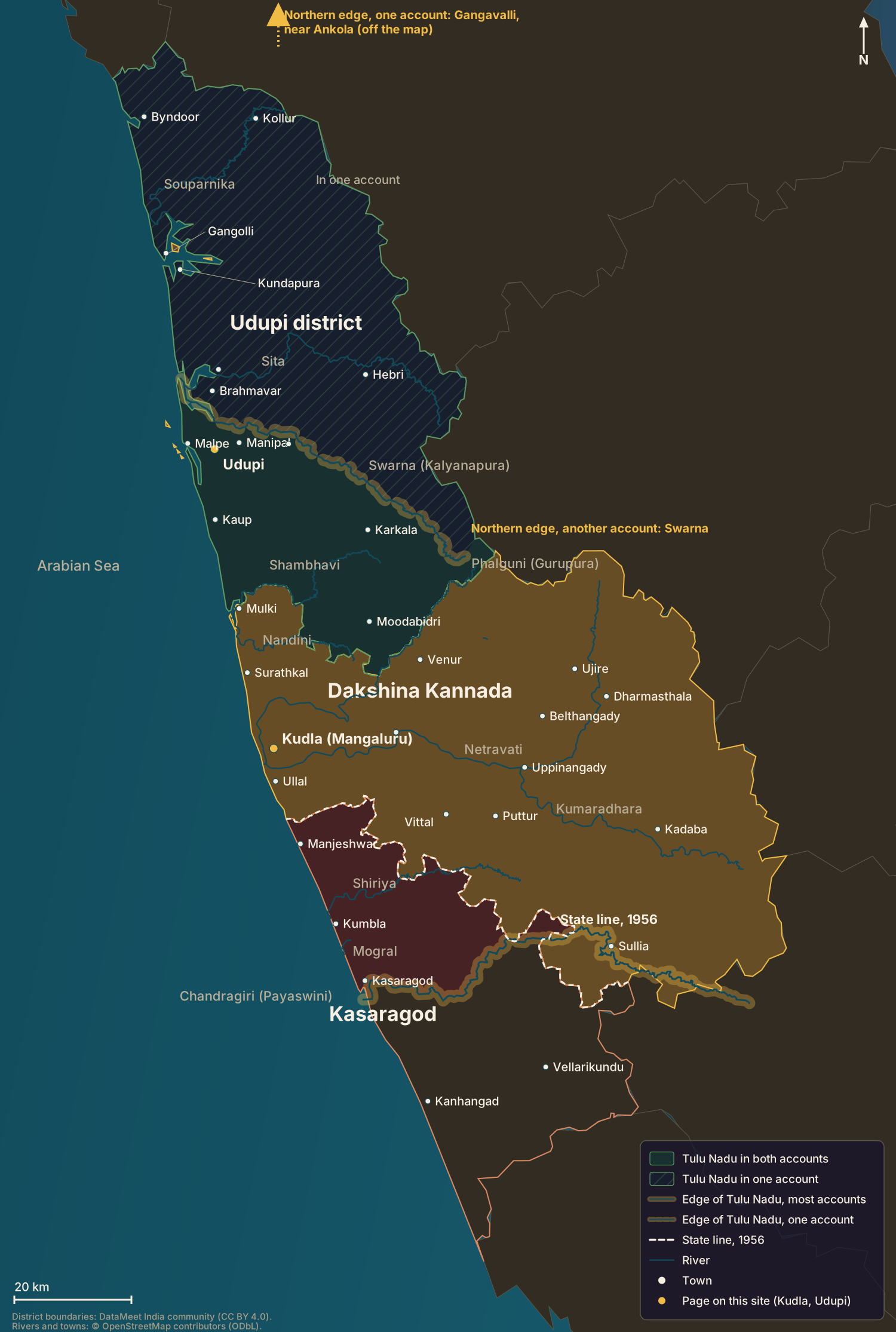
Both answers can be right, because a kingdom’s border and the edge of a language are different lines. Under Vijayanagara, the province called Tuluva Rajya ran from Gokarna in the north to the Chandragiri in the south. That was a name used for governing, and it included some land where people did not speak Tulu 6. In Kundapura and the north of Udupi district, people speak Kundagannada, a form of Kannada 10 3.
What Tulu Nadu has been called
The Alupa kings ruled the coast from about 200 to 1444, by one dating 9. Their origin before the Kadambas is unclear, because no inscription records it 9. Under them the land was called Alvakheda, the land of the Alupas. Inscriptions use that name, and its full form is given as Alvakheda Arusasira 9. The historian B.A. Saletore, in his 1936 book Ancient Karnataka, Vol. I: History of Tuluva, says it was one independent kingdom in the earliest records 6. P. Gururaja Bhat, in Studies in Tuluva History and Culture (1975), also names the Alupas as its main rulers until the fourteenth century 11.
Vijayanagara ran the coast as two provinces, the Barakuru and Mangaluru rajyas. At times the two were joined as one, the Tulu Rajya 2. Saletore used the old text Grama Paddhati and inscriptions to show how far it went, from Gokarna to the Chandragiri 6.
The British made it a district. After Tipu Sultan’s defeat in 1799, the East India Company formed the Kanara district under the Madras Presidency 12. Between about 1859 and 1862 it was split in two. North Canara went to the Bombay Presidency, and South Canara stayed with Madras 12. Undivided South Canara covered 10,410 square kilometres. It had six taluks: the Amindivi Islands, Coondapoor (Kundapura), Kasaragod, Mangalore, Udupi and Uppinangady 13 12. Uppinangady taluk is now called Puttur 13 12.
The line of 1956
The States Reorganisation Act came into force on 1 November 1956 and split South Canara 14. Most of it became Dakshina Kannada district, in the new Mysore state that was later renamed Karnataka 14. Kasaragod taluk, with Manjeshwar, went to the new Malayalam-speaking state of Kerala 14 4. Kasaragod was the one part of South Canara where most people spoke Malayalam 2 4. In the nineteenth century there had already been moves within the taluk to leave South Canara and join Malabar, the Malayalam-speaking district 15 4.
People have argued since then about whether Kasaragod belongs in Kerala 15 4. In the 1951 Census about 72 per cent of its people gave Malayalam as their mother tongue 15 4. About 14 per cent gave Tulu and about 6 per cent Kannada 4. The Kannada poet Kayyara Kinhanna Rai (1915-2015), a Tulu speaker who lived at Badiyadka in the district, campaigned to bring Kasaragod into Karnataka 16. In 2002 he founded the Kasaragod Vileeneekarana Kriya Samithi, the Kasaragod Merger Action Council 16. The reasons on either side are not given here.
The second split was about running the district. On 25 August 1997, Karnataka created Udupi district from three northern taluks of Dakshina Kannada: Udupi, Kundapura and Karkala 17 3. At the 1991 Census the two parts together had about 27 lakh people 2 3.
The districts and their taluks
Dakshina Kannada had five taluks at the 2011 Census. It now has nine: Mangaluru, Bantwal, Puttur, Sullia, Belthangady, Moodabidri, Kadaba, Mulki and Ullal 18 2. The last four were created from the first five 18 2.
Udupi had three taluks in 2011. Since the taluks were redrawn in February 2018 it has seven: Udupi, Kundapura, Karkala, Kaup, Brahmavar, Byndoor and Hebri 3.
Kasaragod had two taluks in 2011. Since the taluks were redrawn in 2013 it has four: Kasaragod, Hosdurg (Kanhangad), Manjeshwar and Vellarikundu 4. Only the north of the district is Tulu-speaking today 4.
The 2011 Census counts of mother tongues show what this means. In Dakshina Kannada about 49 per cent gave Tulu as their mother tongue. Beary and other tongues were about 16 per cent, Malayalam and Konkani about 10 each, and Kannada about 9. Urdu and Marathi were each under 2 per cent 2 19. In Udupi district, Kannada was the largest, at about 42 per cent, mostly the Kundagannada of Kundapura taluk. Tulu came next at about 32 per cent, mostly in the southern taluks 3 10. In Kasaragod district about 83 per cent gave Malayalam and about 9 per cent Tulu. Tulu, Kannada and Konkani speakers live mostly in the north of the district 4.
In September 2026 the Karnataka cabinet decided to make Tulu a second official language in Dakshina Kannada and Udupi districts 20.
The demand for a Tulu Nadu state
After the 1956 reorganisation, Tuluvas began to ask for two things: official status for Tulu, and a separate state called Tulu Nadu 1. Groups such as the Tulu Rajya Horata Samiti have made this demand 1. Meetings and demonstrations for it have been held at Kudla (Mangaluru) and Udupi 1. The region is still not an official unit of government 1.
The main towns
Where a town has a Tulu name of its own, it is in the first column. Where no separate Tulu name is recorded, the first column repeats the Kannada name.
| Tulu name | Kannada name | Official name | District | Source |
|---|---|---|---|---|
| Kudla ಕುಡ್ಲ | ಮಂಗಳೂರು | Mangaluru | Dakshina Kannada | 21 |
| Bantwal ಬಂಟ್ವಾಳ | ಬಂಟ್ವಾಳ | Bantwal | Dakshina Kannada | 22 |
| Bolter ಬೊಲ್ತೆರ್ | ಬೆಳ್ತಂಗಡಿ | Belthangady | Dakshina Kannada | 23 |
| Puttur ಪುತ್ತೂರು | ಪುತ್ತೂರು | Puttur | Dakshina Kannada | 24 |
| Sullia ಸುಳ್ಯ | ಸುಳ್ಯ | Sullia | Dakshina Kannada | 25 |
| Bedra ಬೆದ್ರ | ಮೂಡುಬಿದಿರೆ | Moodbidri | Dakshina Kannada | 26 |
| Kadaba ಕಡಬ | ಕಡಬ | Kadaba | Dakshina Kannada | 27 |
| Ullal ಉಳ್ಳಾಲ | ಉಳ್ಳಾಲ | Ullal | Dakshina Kannada | 28 |
| Surathkal ಸುರತ್ಕಲ್ | ಸುರತ್ಕಲ್ | Surathkal | Dakshina Kannada | 29 |
| Moolki ಮೂಲ್ಕಿ | ಮುಲ್ಕಿ | Mulki | Dakshina Kannada | 30 |
| Ujire ಉಜಿರೆ | ಉಜಿರೆ | Ujire | Dakshina Kannada | 31 |
| Dharmasthala ಧರ್ಮಸ್ಥಳ | ಧರ್ಮಸ್ಥಳ | Dharmasthala | Dakshina Kannada | 32 |
| Ubar ಉಬಾರ್ | ಉಪ್ಪಿನಂಗಡಿ | Uppinangady | Dakshina Kannada | 33 |
| Ittel ಇಟ್ಟೆಲ್ | ವಿಟ್ಲ | Vittal | Dakshina Kannada | 34 |
| Venur ವೇಣೂರು | ವೇಣೂರು | Venur | Dakshina Kannada | 35 |
| Udupi ಉಡುಪಿ | ಉಡುಪಿ | Udupi | Udupi | 36 |
| Kundapura ಕುಂದಾಪುರ | ಕುಂದಾಪುರ | Kundapura | Udupi | 37 |
| Karla ಕಾರ್ಲ | ಕಾರ್ಕಳ | Karkala | Udupi | 38 |
| Kaup ಕಾಪು | ಕಾಪು | Kaup | Udupi | 39 |
| Byndoor ಬೈಂದೂರು | ಬೈಂದೂರು | Byndoor | Udupi | 40 |
| Brahmavar ಬ್ರಹ್ಮಾವರ | ಬ್ರಹ್ಮಾವರ | Brahmavar | Udupi | 41 |
| Hebri ಹೆಬ್ರಿ | ಹೆಬ್ರಿ | Hebri | Udupi | 42 |
| Manipal ಮಣಿಪಾಲ | ಮಣಿಪಾಲ | Manipal | Udupi | 43 |
| Malpe ಮಲ್ಪೆ | ಮಲ್ಪೆ | Malpe | Udupi | 44 |
| Barkur ಬಾರ್ಕೂರು | ಬಾರ್ಕೂರು | Barkur | Udupi | 45 |
| Periyadka ಪೆರಿಯಡ್ಕ | ಹಿರಿಯಡ್ಕ | Hiriyadka | Udupi | 46 |
| Kollur ಕೊಲ್ಲೂರು | ಕೊಲ್ಲೂರು | Kollur | Udupi | 47 |
| Gangolli ಗಂಗೊಳ್ಳಿ | ಗಂಗೊಳ್ಳಿ | Gangolli | Udupi | 48 |
| Kasaragod ಕಾಸರಗೋಡ್ | ಕಾಸರಗೋಡು | Kasaragod | Kasaragod | 49 |
| Manjeshwar ಮಂಜೇಶ್ವರ | ಮಂಜೇಶ್ವರ | Manjeshwar | Kasaragod | 50 |
| Kumbla ಕುಂಬಳ | ಕುಂಬಳ | Kumbla | Kasaragod | 51 |
In Tulu, Kasaragod is written ಕಾಸರಗೋಡ್ (kāsaragōḍ). It only drops the last vowel of the Kannada name 49. For Kumbla no separate Tulu form is recorded, so both name columns give the Kannada form 51.
Rivers, hills and the coast
Eleven rivers of the region are named here. In Dakshina Kannada: the Netravati 52, the Phalguni or Gurupura 53, the Nandini 54, the Shambhavi 55 and the Kumaradhara 56. In Udupi: the Sita 57, the Swarna 58 and the Souparnika 59. In Kasaragod: the Chandragiri or Payaswini 8, the Shiriya 60 and the Mogral 61.
Where a river has a Tulu name of its own, it usually adds the Tulu word sude (ಸುದೆ), river, to the river’s name. So the Tulu names are Kumaradhara Sude, Nandini Sude and Netravati Sude 56 54 52. The Netravati has two Tulu names: an older one, Nelyathar (ನೇಲ್ಯತಾರ್), and Netravati Sude 52.
Kudremukh is 1,894 metres high 2. Its name, horse face, comes from the shape of its ridge 62. Sailors on the Arabian Sea are said to have used it as a landmark for more than two thousand years 62. The Tunga, the Bhadra and the Netravati all rise on it 62. Jamalabad, which local people call Gadayikallu, is a granite rock 1,700 feet high in the Kudremukh foothills 63. Tipu Sultan built a fort on it in 1794 and named it after his mother, Jamalabee 63. It is climbed by 1,876 steps cut in the rock, and the British took it in 1799 63. Near Maravanthe the Souparnika runs beside the sea, with only a narrow strip of land between them 64.
Terms used on this page
- guttu and barke: the leading households of the old village order, with their houses and land. Sources give two views of which communities held each.
Variant: Kundapura and the north of Udupi district
Here people speak Kundagannada, a form of Kannada, not Tulu. The change in speech comes gradually, not at one line on a map.
Variant: Kasaragod district
Only the northern part of the district, chiefly the Manjeshwar and Kasaragod taluks, is Tulu-speaking. Kanhangad and Nileshwar are named in older accounts of the region's extent, and Malayalam is the main language of the district today, at about 83 per cent.
Related
Sources
- Contributors to Wikimedia projects, Tulu Nadu - Wikipedia, en.wikipedia.org, 2004.
- Contributors to Wikimedia projects, Dakshina Kannada - Wikipedia, en.wikipedia.org, 2004.
- Contributors to Wikimedia projects, Udupi district - Wikipedia, en.wikipedia.org, 2005.
- Contributors to Wikimedia projects, Kasaragod district - Wikipedia, en.wikipedia.org, 2007.
- Karnataka State Gazetteer, Dakshina Kannada District (full text, Kannada Gazetteer Department), archive.org, 2011.
- Full text of "Ancient karnataka ,vol. I: history of Tulva", archive.org.
- Contributors to Wikimedia projects, Chandragiri River - Wikipedia, en.wikipedia.org, 2005.
- Contributors to Wikimedia projects, Chandragiri River - Wikipedia, en.wikipedia.org.
- Contributors to Wikimedia projects, Alupa dynasty - Wikipedia, en.wikipedia.org, 2006.
- By Yajusha, Essence & Celebration of World Kundapura Kannada Day - Daijiworld.com, Daijiworld.com, 2024.
- Prof. P., Full text of "Studies In Tuluva History And Culture", archive.org.
- Contributors to Wikimedia projects, Kanara - Wikipedia, en.wikipedia.org, 2004.
- South Canara - Alchetron, The Free Social Encyclopedia, Alchetron.com, 2017.
- Contributors to Wikimedia projects, States Reorganisation Act, 1956 - Wikipedia, en.wikipedia.org, 2005.
- Contributors to Wikimedia projects, Kasaragod - Wikipedia, en.wikipedia.org, 2003.
- Kayyara Kinhanna Rai, Wikipedia.
- About District | Udupi District | India, udupi.nic.in.
- Map of District | District Dakshina Kannada, Government of Karnataka | India, dk.nic.in.
- Census 2011 India, census2011.co.in.
- Karnataka government decides to accord second official language status to Tulu for Dakshina Kannada and Udupi districts - The Hindu, The Hindu, 2026.
- Contributors to Wikimedia projects, ಕುಡ್ಲ - ವಿಕಿಪೀಡಿಯ, tcy.wikipedia.org.
- Contributors to Wikimedia projects, ಬಂಟ್ವಾಳ - ವಿಕಿಪೀಡಿಯ, tcy.wikipedia.org.
- Contributors to Wikimedia projects, ಬೆಳ್ತಂಗಡಿ - ವಿಕಿಪೀಡಿಯ, tcy.wikipedia.org.
- Contributors to Wikimedia projects, ಪುತ್ತೂರು - ವಿಕಿಪೀಡಿಯ, tcy.wikipedia.org.
- Contributors to Wikimedia projects, ಸುಳ್ಯ - ವಿಕಿಪೀಡಿಯ, tcy.wikipedia.org.
- Contributors to Wikimedia projects, ಮೂಡುಬಿದಿರೆ - ವಿಕಿಪೀಡಿಯ, tcy.wikipedia.org.
- Contributors to Wikimedia projects, ಕಡಬ - ವಿಕಿಪೀಡಿಯ, tcy.wikipedia.org.
- Contributors to Wikimedia projects, ಉಳ್ಳಾಲ - ವಿಕಿಪೀಡಿಯ, tcy.wikipedia.org.
- Contributors to Wikimedia projects, ಸುರತ್ಕಲ್ - ವಿಕಿಪೀಡಿಯ, tcy.wikipedia.org.
- Contributors to Wikimedia projects, ಮೂಲ್ಕಿ - ವಿಕಿಪೀಡಿಯ, tcy.wikipedia.org.
- Contributors to Wikimedia projects, ಉಜಿರೆ - ವಿಕಿಪೀಡಿಯ, tcy.wikipedia.org.
- Contributors to Wikimedia projects, ಧರ್ಮಸ್ಥಳ - ವಿಕಿಪೀಡಿಯ, tcy.wikipedia.org.
- Contributors to Wikimedia projects, ಉಬಾರ್ - ವಿಕಿಪೀಡಿಯ, tcy.wikipedia.org.
- Contributors to Wikimedia projects, ಇಟ್ಟೆಲ್ - ವಿಕಿಪೀಡಿಯ, tcy.wikipedia.org.
- Contributors to Wikimedia projects, ವೇಣೂರು - ವಿಕಿಪೀಡಿಯ, tcy.wikipedia.org.
- Contributors to Wikimedia projects, ಉಡುಪಿ - ವಿಕಿಪೀಡಿಯ, tcy.wikipedia.org.
- Contributors to Wikimedia projects, ಕುಂದಾಪುರ - ವಿಕಿಪೀಡಿಯ, tcy.wikipedia.org.
- Contributors to Wikimedia projects, ಕಾರ್ಕಳ - ವಿಕಿಪೀಡಿಯ, tcy.wikipedia.org.
- Contributors to Wikimedia projects, ಕಾಪು - ವಿಕಿಪೀಡಿಯ, tcy.wikipedia.org.
- Contributors to Wikimedia projects, ಬೈಂದೂರು - ವಿಕಿಪೀಡಿಯ, tcy.wikipedia.org.
- Contributors to Wikimedia projects, ಬ್ರಹ್ಮಾವರ - ವಿಕಿಪೀಡಿಯ, tcy.wikipedia.org.
- Contributors to Wikimedia projects, ಹೆಬ್ರಿ - ವಿಕಿಪೀಡಿಯ, tcy.wikipedia.org.
- Contributors to Wikimedia projects, ಮಣಿಪಾಲ - ವಿಕಿಪೀಡಿಯ, tcy.wikipedia.org.
- Contributors to Wikimedia projects, ಮಲ್ಪೆ - ವಿಕಿಪೀಡಿಯ, tcy.wikipedia.org.
- Contributors to Wikimedia projects, ಬಾರ್ಕೂರು - ವಿಕಿಪೀಡಿಯ, tcy.wikipedia.org.
- Contributors to Wikimedia projects, ಹಿರಿಯಡ್ಕ - ವಿಕಿಪೀಡಿಯ, tcy.wikipedia.org.
- Contributors to Wikimedia projects, ಕೊಲ್ಲೂರು - ವಿಕಿಪೀಡಿಯ, tcy.wikipedia.org.
- Contributors to Wikimedia projects, ಗಂಗೊಳ್ಳಿ - ವಿಕಿಪೀಡಿಯ, tcy.wikipedia.org.
- Contributors to Wikimedia projects, ಕಾಸರಗೋಡ್ ಜಿಲ್ಲೆ - ವಿಕಿಪೀಡಿಯ, tcy.wikipedia.org.
- Contributors to Wikimedia projects, ಮಂಜೇಶ್ವರ ಗೋವಿಂದ ಪೈ - ವಿಕಿಪೀಡಿಯ, tcy.wikipedia.org.
- Contributors to Wikimedia projects, Kumbla - Wikipedia, en.wikipedia.org.
- Contributors to Wikimedia projects, ನೇತ್ರಾವತಿ ಸುದೆ - ವಿಕಿಪೀಡಿಯ, tcy.wikipedia.org.
- Contributors to Wikimedia projects, ಗುರುಪುರ - ವಿಕಿಪೀಡಿಯ, tcy.wikipedia.org.
- Contributors to Wikimedia projects, ಕಟೀಲು - ವಿಕಿಪೀಡಿಯ, tcy.wikipedia.org.
- Contributors to Wikimedia projects, Shambhavi River - Wikipedia, en.wikipedia.org.
- Contributors to Wikimedia projects, ಕುಮಾರಧಾರ ಸುದೆ - ವಿಕಿಪೀಡಿಯ, tcy.wikipedia.org.
- Contributors to Wikimedia projects, Seetha River - Wikipedia, en.wikipedia.org.
- Contributors to Wikimedia projects, Swarna River - Wikipedia, en.wikipedia.org.
- Contributors to Wikimedia projects, ಸೌಪರ್ಣಿಕ ನದಿ - ವಿಕಿಪೀಡಿಯ, kn.wikipedia.org.
- Contributors to Wikimedia projects, Shiriya River - Wikipedia, en.wikipedia.org.
- Contributors to Wikimedia projects, Mogral River - Wikipedia, en.wikipedia.org.
- admin, Kudremukh trekking (Horse face) â Karnataka - Nature Admire, Nature Admire - The Spirt of Adventure travel ~ Since 1997, 2024.
- Contributors to Wikimedia projects, Jamalabad - Wikipedia, en.wikipedia.org, 2007.
- Souparnika River – Saitechinfo, Saitechinfo, 2025.
Seen a mistake, or does your village tell it differently? Write to us about this page.
Last reviewed by tulunadu.org on 18 October 2026.